Can’t We Just Do This With AI?
What we found when we asked AI to map and assess patient communities.

Teams that work with patient communities ask us this question more often every month. General-purpose AI assistants (Claude, ChatGPT, Gemini, Copilot) are now on most desks in pharma. Ask one for the patient communities in a disease area, and a list comes back in seconds.
So we tried it, with four searches of the kind teams actually run: breast cancer in the US, hidradenitis suppurativa (HS) worldwide, Rett syndrome worldwide and Wilson disease in Europe. We ran each one through a general-purpose AI assistant on its own, and through the same assistant connected to Axcela Bio’s verified patient community data. Then we compared the answers. In every search, AI alone missed between 60% and 98% of the patient communities.
Our conclusion: AI is a great new piece of technology, and verified data is what makes it reliable. On its own, each falls short. Together, they get the job done in ways we could only dream about five years ago.
Medical Affairs has been here before
We made the Medical Affairs parallel in The Next Decade of Patient Engagement, and it applies here too. Medical Affairs went through a version of this a decade ago. Once publications, trial registries and congress abstracts were searchable, anyone could find the experts in a therapeutic area. Yet Medical Affairs teams kept investing in expert intelligence platforms (and some of us spent years building one of them).
The reason was simple: searching was never the problem, whether you use Google or AI. A search returned names. The work was deciding which names mattered: who was still active, what each expert actually worked on, how they compared on consistent criteria, and what the team had already done with them.
That work needed two things search couldn’t supply. Verified, structured data kept up to date, and a shared record of every relationship so the next person didn’t start from zero.
Patient engagement is at the same point now. AI has made the search fast. The rest of the work hasn’t changed at all.
AI and data are two different things
It’s easy to treat AI and data as one thing, because an AI assistant answers in fluent, confident sentences. They do different jobs. The AI is how you work: it reads, summarizes and writes, and where the data is thin, it fills the gaps by making things up. The data is what you work from.
A public AI assistant works from two sources: what it learned during training, which stops at a fixed date, and whatever it can find on the public web when you ask. That means pages that may be years out of date, communities that never built much of a website, and nothing that tells it which source to trust.
Exhibit 1
Fast and ready to use only when AI works from verified data
From the public web
From verified data
With AI
AI alone
Fast, partial and unchecked. You do the checking.
Axcela Bio with AI
Fast, full and verified. Ready to use.
Without AI
Desk research (in‑house or agency)
Slow and soon outdated. Paid for again every project.
Verified data but no AI
Reliable. Slower to query and hard to standardize across the company.
A better AI model won’t fix this. It will summarize a 2021 community page more fluently, but the page is still from 2021. And verified data is more than fresh: it applies a clear definition of a patient community, types each one, strips out invalid social media links, retires communities that have gone quiet and rates every community on the same dimensions. General-purpose AI assistants do none of that.
Five steps, and where AI alone stops
Working systematically with patient communities generally comes down to five steps.
| Step | The question | AI alone | Axcela Bio with AI |
|---|---|---|---|
| 1. Identify | Which communities are out there? | A list of names, some stale, some missing, and different each time | A standardized answer with linked profiles and the full set of results, the same every time |
| 2. Understand | How big are they, what do they focus on, and who funds them, including our peers? | Focus from websites; size often missing, funding partial | A verified full profile for each: reach, revenue, focus, industry partners, registries and policy activity |
| 3. Prioritize | Who fits our strategy, and how do their capabilities compare? | Nothing consistent to compare on | Every community rated on the same capabilities |
| 4. Collaborate | Who are we working with, and on what? | Nothing about your company; that history lives in inboxes, spreadsheets and people’s memories. | Your partner record, linked to the community profile and searchable by condition and more |
| 5. Review | What did we do, did it work, and how do we build on it? | No record to review; reviews are usually ad hoc | Activities, projects and insights in one place, ready to report and plan what’s next |
Each answers a different question, and AI alone gets less far at each one. The first two steps run on public information, so we could measure how far AI alone gets. The last three depend on criteria applied the same way every time, and on your company’s own history. AI alone has neither.
Steps 1 and 2: what we tested
For each of the four searches, we compared the number of patient communities each approach identified.
Exhibit 2
AI alone missed between 60% and 98% of communities
Number of patient communities identified
Breast cancer
US · large landscape
Hidradenitis suppurativa
Worldwide · mid-sized landscape
Rett syndrome
Worldwide · rare landscape
Wilson disease
Europe · rare landscape
Method: each search was run in Claude Opus 5.5 with web search, once on its own and once connected to Axcela Bio through our MCP connector, with the same prompt. It asked for a complete list of patient organizations per condition and region, with website, social links, type, size, focus, funders and recent activity.
Counts include dedicated communities, which focus on the condition, and related communities, which cover it as part of a broader focus, such as liver disease for Wilson or psoriasis for HS.
Each panel uses its own scale. Runs from November 2026.
What we found
The gap depends on the size of the landscape. In breast cancer, a large and fragmented field, AI alone found only 2% of the communities. In HS, a mid-sized landscape, it found 40%. In the two rare diseases it came a bit closer on the dedicated groups, because umbrella organizations and drug makers already publish lists of them.
Beyond the dedicated communities, the bigger difference is in related communities: broader liver, skin or rare-disease groups that name the condition in their work. These are important and may be your only alternative when dedicated groups are missing in a country or region. AI alone found almost none of them, yet they are often larger than the dedicated groups and hold most of the industry relationships.
On step 2 (Understand), Axcela Bio provided a standardized profile for each result in Claude, with links back to the full profile in Axcela Bio. This included, among other things, tiering and social channels for nearly every community, while AI alone often left these blank for lack of data. AI alone also listed organizations that no longer exist or work on something else.
The difference that matters most for repeat work is predictability. Ask AI alone the same question twice and you get different lists, so nothing can be compared, tracked or handed over. Every answer from Axcela Bio with AI links to the same search in Axcela Bio, which returns the same standardized list every time, with identical fields for every community. From there, you can save the communities you care about, yourself or by asking our agent to save them, compare them side by side, and look into specific aspects of one or several. That lets a team apply the same approach to landscape analysis across every condition and country it covers, update the results next quarter, and bring them into its own systems. It is also where step 3 begins.
Steps 3 to 5: what AI alone cannot do
The last three steps depend on things no public source holds: criteria applied the same way to every community, and your company’s own history with them.
On step 3 (Prioritize), Axcela Bio rates every community on the same dimensions, such as research and evidence or industry collaborations, from emerging to leader. A prompt can apply your criteria once. It can’t apply them the same way to hundreds of communities, every time.
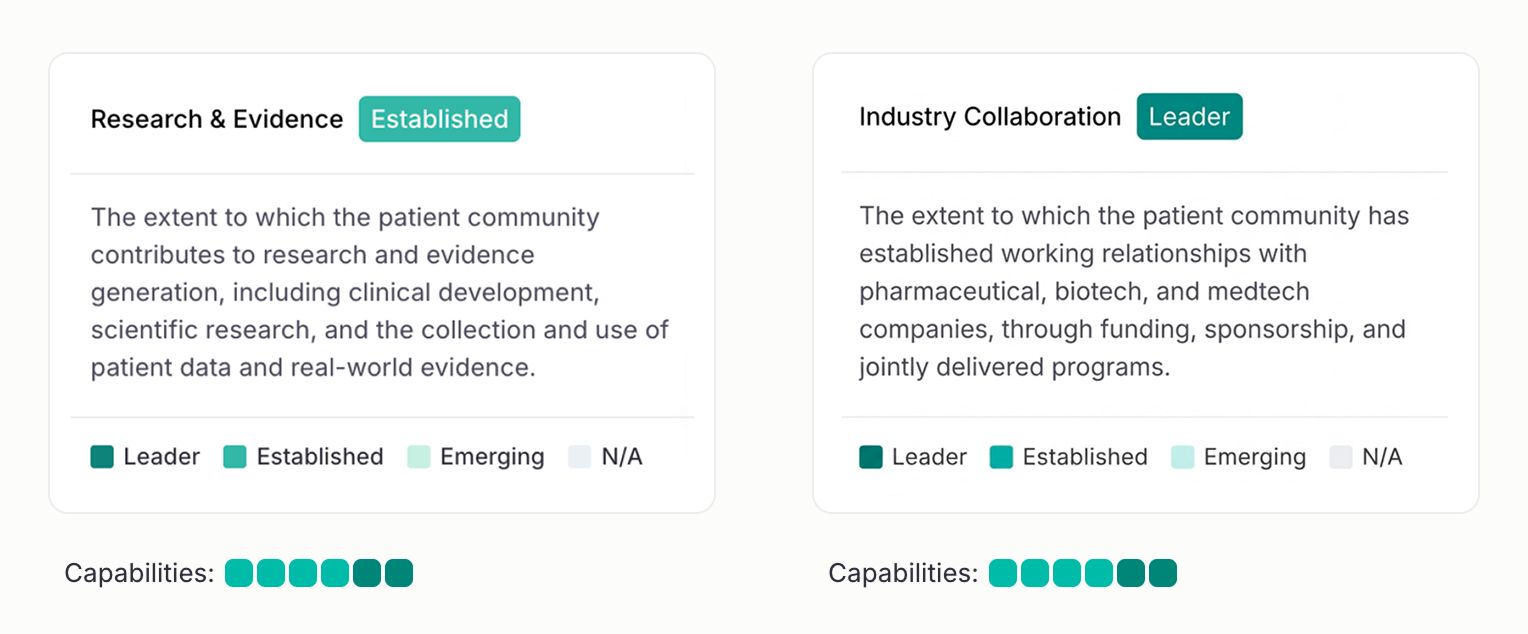
On steps 4 and 5 (Collaborate and Review), AI alone has nothing to work from, because your partner history lives in email, spreadsheets and people’s memories. In Axcela Bio, we have made that history easy to keep: each partner record is linked to the community profile, with activities, projects and insights in one place, searchable by condition and ready to report to leadership.
We’ll look at steps 3 to 5 in more depth in upcoming posts.
The real cost of building it yourself
Some companies choose to build their own patient community database and connect their AI model to it. It can be done. The AI is the easy part, and models keep improving. The real cost is in the data:
- Building it. We have spent years on this, sifting through millions of different data points. Most teams don’t have that time. The range is enormous: some communities are billion-dollar organizations with annual reports, others are parents with a sick child and a Facebook page. Before a community appears in Axcela Bio, we review its activities, structure, and history, and verify its role in supporting or representing patients.
- Keeping it current. Patient communities merge, change names, close, and move to new channels. Smaller, volunteer-run groups may pause their activities with little notice, while news and events change week to week. Without constant upkeep, the data goes stale, and the AI repeats it with confidence.
- Capturing your own history. Partner records only exist if people enter them, and often they don’t. In our research, several Patient Engagement and Advocacy leaders told us they had scaled back, or discontinued, their CRM systems because too few people used them. Without that history, an in-house AI has nothing to draw on for steps 4 and 5.
Each of these needs a standing team, not a one-off project.
Use the best AI. Connect it to verified data.
AI is a great new piece of technology, it will keep getting better at reading, summarizing and writing, and more patient-focused teams will use it every year. What AI can’t do on its own is decide which communities to prioritize, keep their details current, or remember what your company has done with them.
You want (and need) the best of both worlds: the best AI you can get, working from verified and trusted data.
Three questions to ask before you build:
- If you ask your AI the same question next quarter, will you get the same answer?
- Can it tell you which of those communities your company already works with and how?
- Who on your team would keep the data current over time?
Your time is better spent building trusted relationships with the communities themselves.